
Travel's Philosopher & Conformist Problem
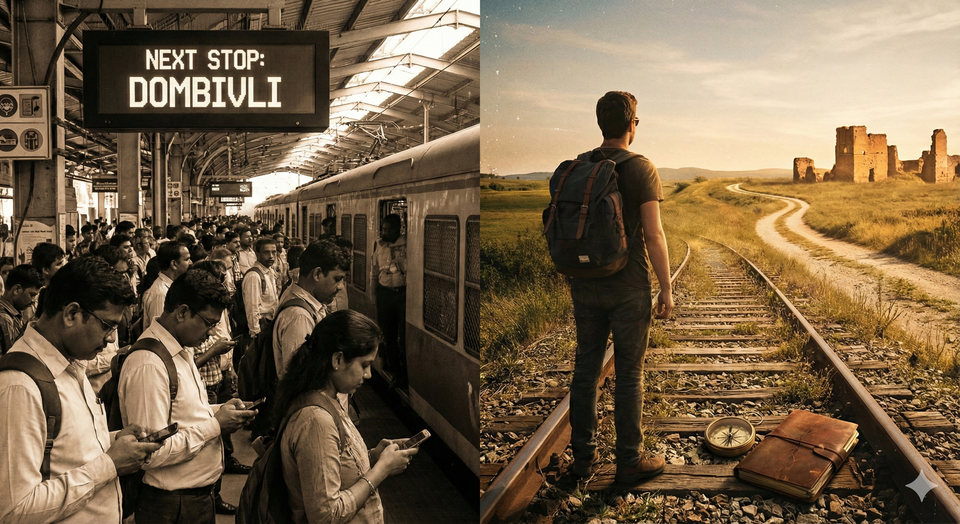
When I used to travel by train, I stayed in Dombivli & I used to always make sure I didn’t miss my station. It was a constant effort to make sure you know when your station is going to come and then get down; at times I have missed it & gone to the next station, which is Thakurli, and even beyond that to Kalyan.
There is always a going joke around people on the western lines about how if you have boarded a Virar fast & wanted to get down at Borivali or even Andheri, that itself is a big task, and you might as well just skip your station.
When you are in a taxi going to a familiar place, your office or maybe someone's house, if you see that the driver is taking a different route, you are always cautious & feel like something is off. You always want to stick to the path.
This is something that is so ingrained in us. The alertness. The mental tracking. The silent anxiety of deviation. And this is the mould that completely breaks when you travel.
---
Travel is supposed to be the antidote to routine. The escape from the familiar. Yet if you look at how the industry has evolved—and how we've evolved as travellers—something peculiar has happened.
We've turned the very act of exploration into a conformist exercise.
At the product level, everyone's building the same thing. Every OTA looks the same. Every hotel booking flow is identical. The flights comparison grid hasn't fundamentally changed in 15 years. The industry has optimised for conversion, not discovery. For efficiency, not experience.
At the experience level, we've outsourced our curiosity to algorithms. The top 10 things to do in any city are now a homogenised list recycled across a hundred travel blogs, all sourcing from the same TripAdvisor reviews. The "hidden gem" you discovered? 47,000 other people discovered it the same way.
At the ground experience level, even the supposedly authentic local experiences have been productised. The walking tour, the cooking class, the "local market visit"—these are now packaged, listed on GetYourGuide, and reviewed with star ratings. The spontaneity has been templated.
And at the level of choices, we've become creatures of social proof. We go where others have gone. We stay where others have stayed. We take photos where others have taken them - often in the exact same angle - because we saw it on Instagram first.
The conformism runs deep.
---
But here's what I find fascinating. Travel was originally considered essential for intellectual & philosophical development. Not as an escape, but as an education.
The ancient philosophers didn't travel to relax. They travelled to think differently.
Herodotus, the Greek historian, wandered through Egypt, Babylon, and Persia—not for Instagram content, but to understand how civilisations worked differently. He came back with observations that shaped Western thought for centuries. His entire method was: go see, then question everything you assumed.
Ibn Battuta covered 75,000 miles over 29 years. He started as a pilgrim and became, essentially, an anthropologist. His observations of legal systems, governance, trade practices across the Islamic world weren't just travel notes—they were comparative analysis.
The Grand Tour of the 17th and 18th centuries was considered mandatory for young European aristocrats. Not because it was fun, but because exposure to different art, architecture, languages, and political systems was considered essential for developing judgment. Travel was a curriculum.
Montaigne travelled for three years through Europe, partly for health, but mainly because he believed direct observation was superior to book learning. His essays are full of insights gained from seeing how things were done differently elsewhere.
The common thread? These weren't vacations. They were conducting field research to understand life itself.
Travel was supposed to break you out of your assumptions. To make the familiar strange and the strange familiar. To force confrontation with the limits of your own worldview.
---
And this brings me back to the train.
In daily life, we optimise for not getting lost. The entire point is to arrive at the expected destination via the expected route. Deviation is failure. Missing your stop is a problem to be solved.
But the philosophical promise of travel is precisely the opposite. Getting lost is the feature, not the bug. The unexpected route is where the insight lives. The missed station—metaphorically—is often where life gets interesting.
I always ponder whether we've lost something important in the way we travel now.
We've gotten extraordinarily good at logistics. We can book a flight in 90 seconds. We can find accommodation in a new city faster than we can order lunch. We've made travel frictionless.
But have we made it meaningless?
When Airbnb first launched, the pitch wasn't "cheaper than hotels." It was "live like a local." That philosophical promise got slowly replaced by professional hosts, key code lockboxes, and reviews optimised for Super-host status. The efficiency killed the serendipity.
When OTAs first disrupted travel agencies, the promise was access—you could now go anywhere, discover anything. That got replaced by ranking algorithms that show you what everyone else is booking. The democratisation became homogenisation.
The infrastructure of travel has never been better. The philosophy of travel has never been more confused.
---
I think there's an opportunity here. Not just for travellers, but for anyone building in this space.
What if the next wave of travel isn't about more efficiency, but more intention? What if instead of optimising for conversion, we optimised for transformation—even in small ways?
The philosophers who travelled weren't looking for convenience. They were looking for confrontation with different ways of being. They went specifically because it was uncomfortable. Because the disorientation was the point.
Maybe we need to build products that help people get a little lost again. That breaks the conformist pattern. That reminds us why travel mattered before it became just another thing we optimise.
The train from Dombivli to Kalyan taught me to stay alert, to not miss my stop.
But maybe travel should teach us the opposite. To miss our stop on purpose. To take a different route. To let the deviation become the destination.
That's the philosopher's approach to travel. And I think we could use more of it.
Member discussion